The original online casino software was developed in the mid-1990s by small teams with limited resources, assumptions of narrow bandwidth, and no obvious idea of what a digital gambling environment should look like or feel like. The interfaces they created pixelated card tables, hand-drawn chip graphics, crude animation loops were functional compromises influenced by the technical limitations of their time. They were also, in hindsight, the pioneering documents of a visual and interactive culture that today is accessed by hundreds of millions of people around the world.
In Australia, where the online gambling market developed early and produced some of the first locally adapted digital casino interfaces, the question of preservation has begun to attract attention from both heritage institutions and player communities — Caswino online casino, registration, sign in lead directly to Caswino official login page on the official website, where the AU-licensed platform’s design lineage connects directly to the first generation of Australia-facing digital casino interfaces whose visual and functional vocabulary shaped everything that followed.
That lineage is worth tracing — and worth preserving — before it disappears entirely.
Why Early Casino Software Qualifies as Digital Heritage
The argument that early online casino software should be treated as cultural heritage is based on the same grounds as that which underlies the preservation of any first-generation technology: it records a point of origin, it reflects the material and intellectual limitations of its time, and it cannot be recreated based on subsequent versions since the tradeoffs and decisions that constituted it were made once and then replaced.
Another major document of the early commercial internet is early casino software. One of the earliest commercial transactions over a public network was the first online gambling sites – they were testbeds of early payment processing, early user authentication, early content delivery within bandwidth limits, and early interface design to non-technical consumer users. The design choices that were undertaken in those laboratories influenced the evolution of e-commerce, online entertainment, and digital interaction design far beyond the gambling industry.
The visual language of early online gambling, the particularization of playing cards, the depiction of physical casino items in two-dimensional digital space, the colour codes that became standardized throughout the industry, is also an important part of the history of digital graphic design. To know the origin of those conventions, and their development, we need to have the original artefacts. That knowledge is impossible without conservation.
Virtual Cards as Design Artefacts

In 1996, the problem of displaying a playing card on a screen was not that simple. Display resolutions, colour depths and rendering capabilities were limited and designers had to make basic decisions about what visual aspects of the physical card were necessary and what could be compromised. Their solutions, the particular proportions, the colour schemes, the treatment of the symbols of suits, the treatment of the face cards illustrations, were design decisions under pressure, and they set conventions on which the whole further history of the design of online card games has been based.
Early casino card design has been found by design historians to be an important but under-researched field in the evolution of digital graphic conventions. The limitations imposed by those designs, the requirement to be readable at small sizes, to be acceptably displayed on various display hardware, to convey acceptably the information of suit and value without the tactile feedback of a physical card, created solutions that shed light on the history of designing to digital screens at a time when the parameters of that design problem were still being defined.
The rediscovery and documentation of such original design artefacts is, in principle, the same sort of work that design museums perform on industrial design objects or typographic specimens. The same is the argument in favor of doing it: to know where the current conventions originated, one needs to have access to the decisions that created them.
The Preservation Challenge — Emulation, Licensing, and Access
The conservation of early casino software is confronted with a set of technical and legal challenges that are common to digital heritage organizations but especially severe in the gambling industry. The technical difficulty is emulation – executing software written to run on outdated operating systems on modern hardware in a manner that recreates the original experience. This can be done in principle but involves a lot of technical investment and the results are approximations of the original and not direct reproductions.
The legal issue is more difficult. Early casino software is often proprietary-licensed, which means that heritage institutions are not allowed to archive, reproduce, or otherwise make available the code and assets used. In contrast to physical cultural artefacts, in which the owner of the object usually has the right to preserve it, digital software preservation demands rights which must be actively conferred by the intellectual property owners concerned.
Australian platforms that have maintained continuity from early digital casino design traditions represent a different kind of preservation — living continuity rather than archival recovery — and Degencity casino offers AU heritage researchers a working example, where online casino registration and sign in flows lead directly to enter Degen City login on the official website, demonstrating how Australia-market design conventions established in the early decades of digital casino culture continue to shape contemporary platform architecture.
Who Is Doing the Work — Institutions, Communities, and Individual Collectors
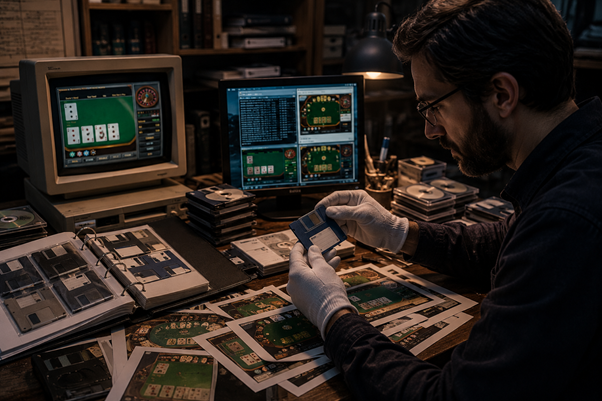
The current preservation efforts of the history of early casino software are spread among institutional and informal actors with highly disparate resources and practices. Few digital heritage organisations have initiated systematic documentation programmes, which are mainly concerned with documenting what was there, rather than restoring working versions of what has been lost.
Communities of online gaming history On-line gaming history communities forums, wikis, collector networks around the history of digital gambling have generated substantial documentation through crowdsourcing. The screenshots, gameplay videos, and design histories that would not have been possible without voluntary community work have been archived by individual contributors. The resultant documentation is patchy in quality and coverage but is the most comprehensive record that exists to date of many early platforms.
The institutional archives have not captured certain artefacts that have been preserved by individual collectors: installation packages, promotional materials, correspondence of early developers. Their collections are privately held and closed by default, although some have donated materials to new digital casino history projects which are starting to bring together fragmented resources into more organized archives.
What a Serious Preservation Programme Would Look Like
The systematic digital casino heritage preservation programme would need a number of elements that are either not present or not developed. The key to recovery work beyond documentation of what survived by chance is institutional commitment by national digital heritage bodies, which have the resources and legal standing to negotiate licensing access with intellectual property holders.
In a number of jurisdictions, legal reform would broaden what heritage institutions may archive and access without negotiation with individual rights-holders. A number of nations have already created heritage exemptions in copyright law to cover software preservation; extending the exemptions to the casino software category in particular would eliminate the largest legal obstacle to systematic recovery work.
According to the Internet Archive, the preservation of early commercial software — including gaming platforms — represents one of the most pressing and most underfunded challenges in digital heritage, with hundreds of thousands of programs already beyond recovery and the window for capturing the remaining first-generation digital culture narrowing with each passing year. The history of early online casino software sits squarely within that window, and the decisions made in the next decade about whether to treat it as heritage worth preserving will determine whether that history remains recoverable at all.